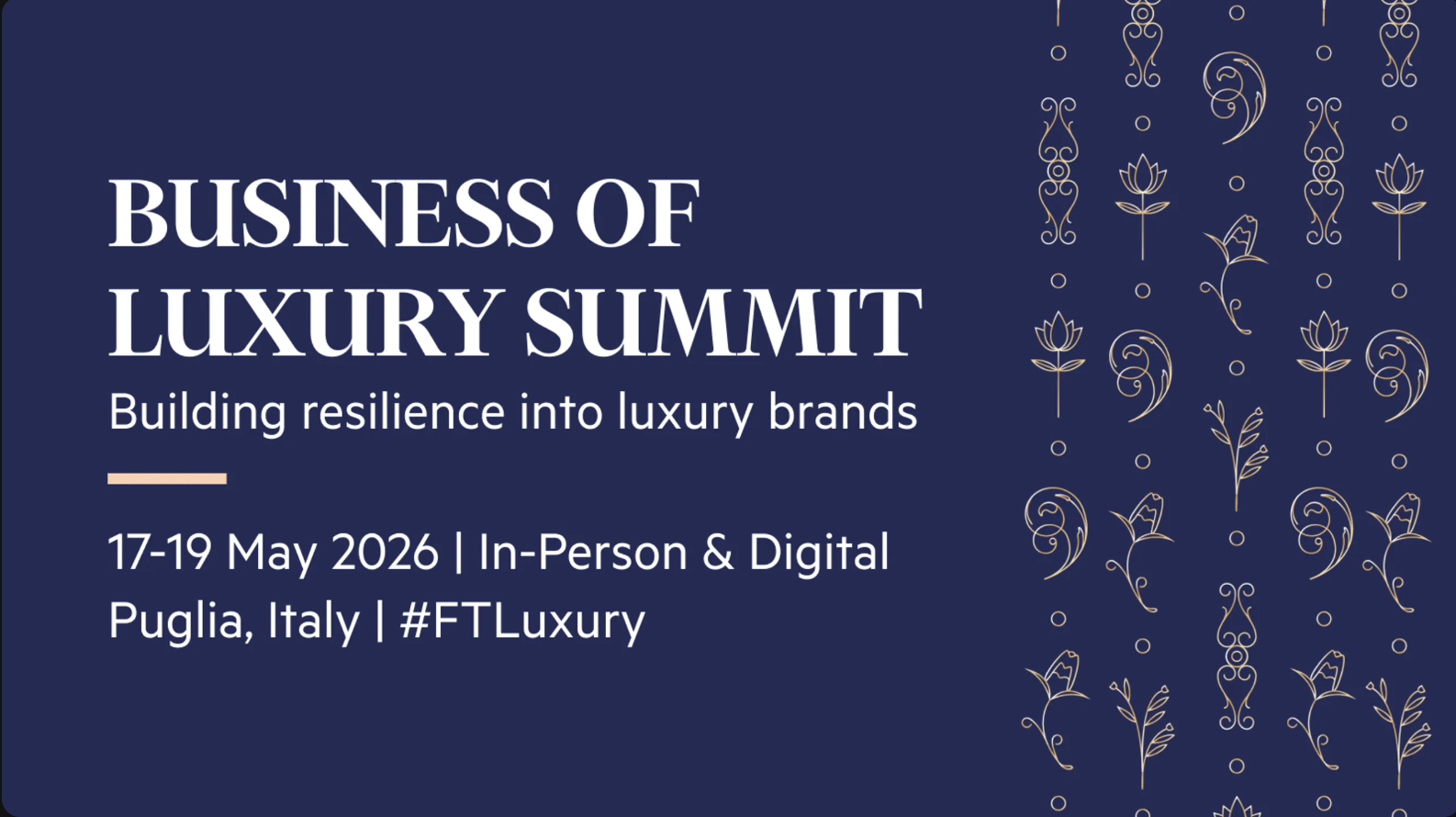
My takeaways from the FT Business of Luxury Summit 2026
Luxury brands are regrouping. In the face of political and economic uncertainty, the luxury industry is re-evaluating what luxury means and where its value genuinely lies. And — surprise, surprise — financial growth and performance-based KPIs are not necessarily the core drivers of luxury success, but rather the consequence of a customer-centric strategy grounded in experience (Simon Mitchell, Sybarite).
I was particularly glad to see the business discourse finally pivot towards concepts that integrate business practice with humanistic perspectives — themes that my colleagues and myself in socio-cultural academic research and industry insights have been exploring for decades.
Businesses need to become ethnographers: brands are called to develop a deeper understanding of consumers and a more nuanced view of their lived experiences — whether connecting with younger generations via their renewed closeness to books and organic socialisation as a form of digital detox (Joanne Crevoiserat, Coach), or luxury brands engaging with sports by understanding the specific cultures of fan communities (Eric Vallat, Lacoste).
Businesses have to also become storytellers: storytelling lies at the very core of human connection and socialisation, and this reminded me of the ancient Greek tradition of the Aoidoi, who travelled from village to village sharing stories and poems. They cannot simply entertain; they have to create worlds, moments of shared emotion, and deep connections with their audiences (Omer Acar, Raffles & Fairmont Hotels & Resorts).
“It is not a logo play, it is a storytelling play.” (Nikolaus von Doetinchem, PJL )
Finally, businesses are strengthening their roots in both place and time:
- They are investing in the sense of place, through the preservation of local industrial districts and the regulation of supply chains (Carlo Capasa, Camera Nazionale della Moda Italian; Matteo Lunelli, Ferrari Trento; Cristiano Fiori, Maserati), and by placing experience in retail and hospitality at the centre of value delivery (Aldo Melpignano, Egnazia; India Mahdavi, India Mahdavi Studio).
- They are integrating both “left” and “right” brain approaches — combining traditional short- and long-term financial measurement with qualities such as empathy and intuition (Stephane de La Faverie, Estée Lauder). After all, the word “crisis” comes from the Greek verb krino, meaning “to decide”. Corporate decision-making today must balance and reconcile a variety of perspectives, operating at the crossroads between heritage and innovation (Cedric Charbit, Saint Laurent), creative expression and strategic savviness (Floriane de Saint Pierre, Floriane de Saint Pierre & Associates; Thom Browne, Thom Browne; Delphine Arnault and Jonathan Anderson, Dior), as well as patience and agility (Ermenegildo Zegna, Zegna).
And what about the elephant in the room (AI)? Again, I was pleased to see that the general view is not about plugging AI into every aspect of value delivery processes indiscriminately, but rather integrating it in support of the final code of luxury value: excellence delivered from humans to humans (Claudia D’Arpizio, Bain & Company).
I am currently working with my colleagues on data-driven research projects addressing some of these hot topics, namely the collaborative tensions between luxury brands and Web3 agencies, as well as place experience design in luxury, art, and culture.
Excited to see how the dialogue between academia and the luxury industry continues to unfold.